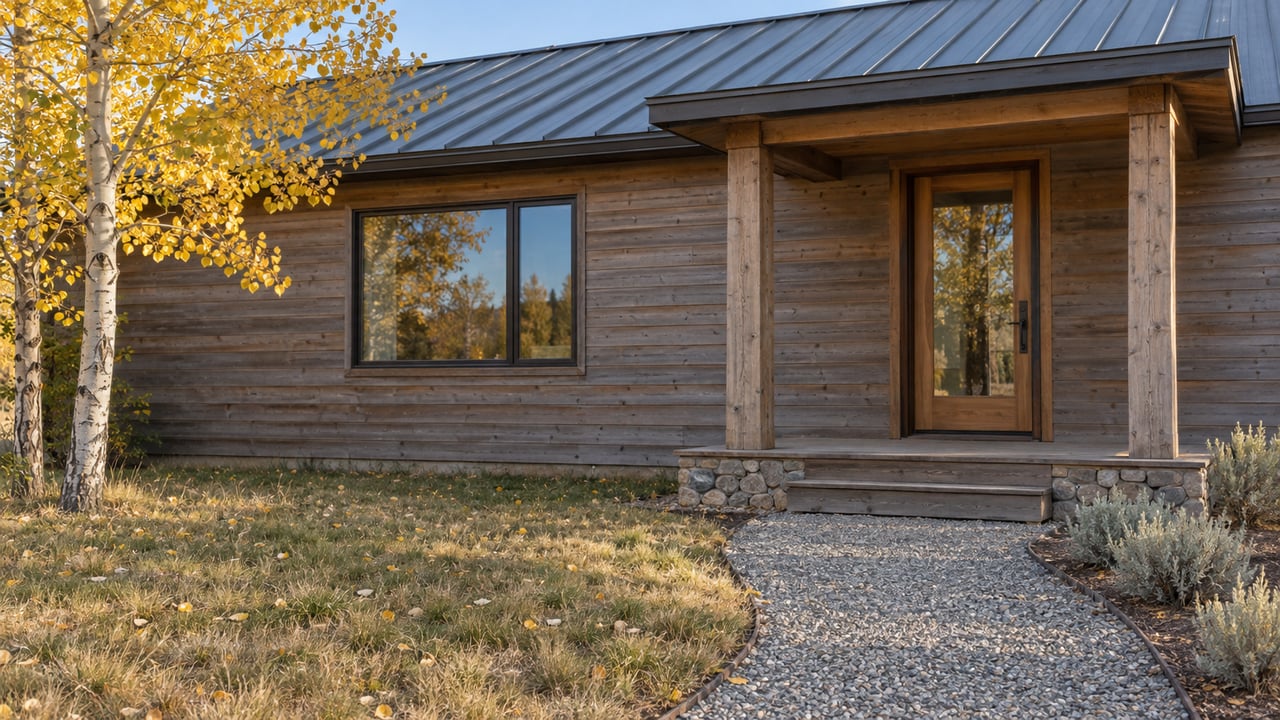
Lake City Now Allows Backyard Cottages, Just Not the Kind Second-Home Owners Picture
October 15, 2026
October 15, 2026
"ADUs are intended to provide long-term workforce housing for year-round workforce and aging-in-place occupants. ADUs shall not be used for short-term rentals, office space, or guest quarters."
That sentence comes from Section 23-27 of the Lake City Municipal Code. The Town of Lake City Board of Trustees added it with Ordinance 2026-06, which passed after a public hearing on July 1, 2026. Most of the ordinance loosens the rules. Accessory dwelling units are now a use by right in seven zoning districts, they can be detached, and approval happens at the staff level with no public hearing. The last clause of that purpose statement points the other way, and it decides how much a backyard unit is worth to the people most likely to buy in town.
A lot of buyers picture the same setup. They want a main house for themselves and a small cabin out back for visiting family, or one that rents by the week through the summer to help with the mortgage. Inside Lake City's town limits, an ADU approved under the new code can do neither of those things. What it can do is house a long-term tenant, with tenancies of at least 31 days. The town built that rule on purpose, and the reasons explain both the rule and the hookup costs a buyer will run into.
The ordinance replaced an older and narrower ADU definition. The two versions side by side:
| Before Ordinance 2026-06 | After Ordinance 2026-06 | |
|---|---|---|
| Form | Attached to a single-family home or a private garage | Internal, attached, over a garage, or detached on the same lot |
| Minimum floor area | 440 sq ft | 300 sq ft |
| Maximum floor area | 1,800 sq ft | 1,000 sq ft |
| Approval | Not specified in the old definition | Use by right, administrative staff-level review, no public hearing |
| Permitted use | Not specified in the old definition | Long-term rental only, 31-day minimum; no short-term rental, office, or guest quarters |
ADUs are permitted by right in the Rural, R-1, Rural Estate, LM, T, T-2, and MHR districts. Every unit needs its own dedicated entrance and has to sit on a foundation. RVs, campers, trailers, and other temporary structures don't count as ADUs. Modular prefabricated units are allowed. An off-street parking space is required only when three conditions are all true: the lot has no existing off-street space, the district requires parking for the main house, and on-street parking is prohibited on that block.
The ceiling dropped from 1,800 to 1,000 square feet, and the floor dropped from 440 to 300. The town made small detached units easier and big secondary houses harder. Those limits favor a smaller unit over a second family home.
The ordinance also defines who it has in mind. A "Workforce Occupant" works at least 30 hours a week in Hinsdale County or an adjoining county. An "Aging-in-Place Occupant" is 60 or older, or receives federal or state disability benefits, and has lived in Hinsdale County for at least a year before moving in. Those definitions sit in the purpose statement. The enforceable rental restriction in the text is the 31-day minimum and the short-term rental prohibition. A buyer with a particular use in mind should confirm with Town staff how the occupant definitions are applied.
The ordinance grows out of the Comprehensive Housing Plan, which the Town and Hinsdale County adopted on February 18, 2026. That plan names ADUs as one of "the easiest and quickest ways to address the local housing shortage with minimal infrastructure impact." The figure behind the urgency comes from the Silver World's coverage of the final plan, which reported a 72 percent vacancy rate in Lake City. Most of that comes from second and vacation homes. The same article quoted the plan's employer survey: "We just need more housing in general. Affordable or not, it just needs to be here."
If 72 percent of homes sit empty for much of the year, a new backyard unit tends to drift toward the same seasonal use. It becomes a guest room for July or a nightly rental for Alpine Loop traffic. The guest-quarters and short-term rental bans are there so new units add to the year-round housing stock and not to the seasonal one.
There was also a practical payoff. The Planning & Zoning Commission reviewed the ordinance on February 26, April 2, and April 23, 2026, and recommended the short-term rental prohibition as the town's first "ADU Supportive Strategy" under the state's ADU law, House Bill 24-1152. It worked. In a letter dated August 7, 2026, the Colorado Department of Local Affairs certified Lake City as an ADU Supportive Jurisdiction. DOLA cited two strategies: help with ADU-related fees for low- and moderate-income households, and a program regulating short-term rental use of ADUs. The letter also says the certification lasts only until a local action conflicts with the criteria. The short-term rental ban is part of what keeps that certification in place, which makes it unlikely to loosen any time soon.
A long-term rental pays back over years, and the size of the upfront bill decides whether it pays back at all. In Lake City, most of that bill depends on one line in the ordinance. ADUs "may utilize a common water and/or sewer tap from the primary residence where feasible and with written approval from the Town," under the connection conditions in Section 21-22 of the municipal code.
The Town's 2026 fee schedule shows how much that matters. A separate 3/4-inch or smaller connection carries these charges:
That comes to $13,000 in plant investment fees before any trenching or plumbing. Under Section 21-22, the same schedule lists a $750 per-tap administrative fee for deferring the separate water and sewer tap requirement. If the Town approves a shared tap, the fee difference between the two routes is large. The words "where feasible" leave the Town room to decide case by case. The line size at the main house, the distance to the new unit, and the main line's condition can all affect the answer.
Monthly carrying costs follow the same logic. Under the 2026 water and sewer rate notice, a single-family home inside town pays a $96.80 water base and a $135.95 sewer base each two-month billing period. That's $232.75 every other month, or $1,396.50 a year, whether anyone is home or not. The same notice raised the town's multi-unit sewer surcharge from 25 to 35 percent of the base for each unit after the first, which works out to $47.60 per unit per billing period. The rate notice doesn't say whether a shared-tap ADU is billed as an additional unit. If it is, that's about $285 a year on top of the base. Ask Town staff before running rental numbers.
These rates trace back to a decision made in late 2024. The Silver World reported that trustees adopted a sewer rate structure recommended by the Rural Community Advocacy Corporation after the state told the town its old rates weren't enough to support a loan for renovating the Wastewater Treatment Plant. Town Manager Lex Mulhall told the paper, "You have to be charging your water and sewer customers correctly in order to get grants and loans for these infrastructure projects." The same restructuring is why county customers on the town system pay more. Their 2026 base rates are $116.40 for water and $163.15 for sewer. The ADU ordinance is a Town zoning change, so those county properties fall under Hinsdale County's land use code, not Section 23-27.
The ordinance doesn't touch short-term renting of a primary home. The 2026 fee schedule still lists a one-time $100 short-term rental application fee and an annual conditional use permit fee in residential zones of $300 for one bedroom, $400 for two, $500 for three, and $600 for four or more. In January 2026, the Silver World described the town's work on possible redefinitions of lodging, ADUs, and short-term rentals as very preliminary.
So a buyer who wants vacation rental income has a clearer target than before. It's the main house, under a permit. A buyer who wants space for visiting family is looking at a bigger main house. The ADU is suited to one job, renting to a tenant who stays at least a month.
Two more rules apply on certain lots. ADUs inside the Historical Preservation District also have to comply with Lake City's historic preservation regulations, and every ADU has to meet adopted building, fire, and energy codes. On a historic-district parcel, those preservation rules apply in addition to the ADU standards.
The ADU ordinance is the part of the housing plan that already has teeth. The larger pieces are moving more slowly.
Can I build a guest cabin for family visits under the new Lake City ADU rules? Ordinance 2026-06 says ADUs "shall not be used for short-term rentals, office space, or guest quarters." A unit approved under it is meant for long-term rental with a minimum 31-day tenancy.
Does the ordinance apply outside town limits? It amends the Town of Lake City's municipal code and lists Town zoning districts. Unincorporated Hinsdale County has its own land use code, which the County has asked its Planning & Zoning Commission and attorney to review and update.
Is a separate water and sewer tap required? Not always. The ordinance allows a shared tap from the main house where it's feasible and the Town approves it in writing. The 2026 fee schedule lists $13,000 in plant investment fees for a separate 3/4-inch connection and a $750 per-tap fee for deferring separate taps.
Can a modular unit work? Yes. Modular prefabricated units are allowed as long as they sit on a foundation and meet adopted codes.
If you're looking at a Lake City property and wondering whether the lot can take an ADU, a shared tap, or a long-term tenant, I'm happy to help you sort out the details with Town staff before you commit. Let's Connect with John Bobby Overturf.
This article is general information, not legal, tax or financial advice. Consult a qualified professional about your situation.
Stay up to date on the latest real estate trends.
I pride myself on informing and educating my clients to make better real estate decisions. Contact me today to find out how I can be of assistance to you!